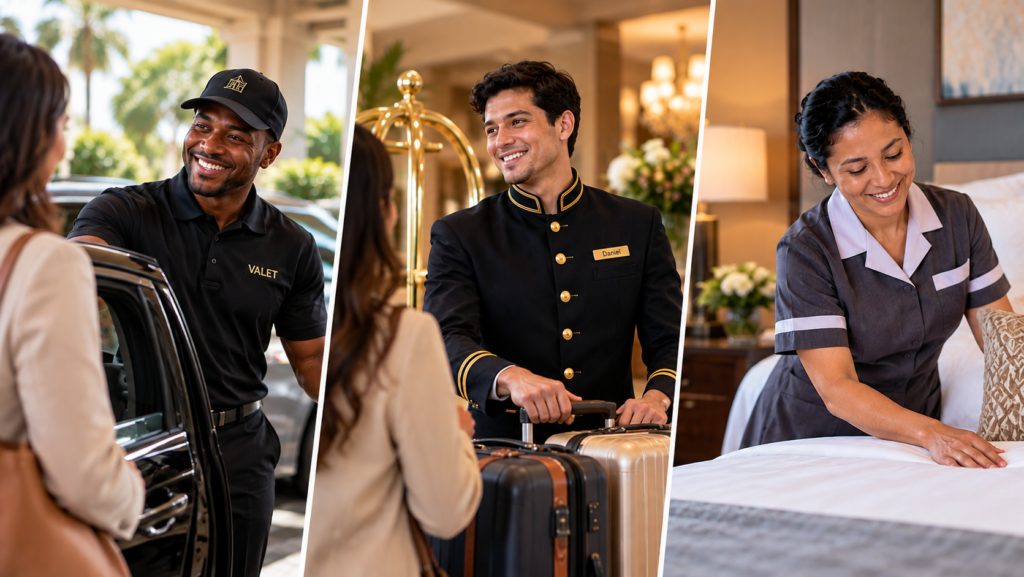
Ask a hotel GM what their digital tipping program looks like and you will usually get an answer that describes one role. The bar has a tip prompt on the POS. The valet stand has a QR code. Housekeeping has — well, housekeeping has always been complicated.
That fragmentation is not a technology problem. It is a design problem. And it is costing hotels more than they realize, not just in missed tip income but in the workforce signal it sends to every person on the team.
A tipping program that works for some roles and not others is not a tipping program. It is a patchwork.
Hotel GM, New York City
And patchworks have gaps — and the people who fall through those gaps notice.
Three roles. Three completely different service moments.
The valet: a bookended moment
The valet’s interaction with a guest is bookended. Arrival and departure. Two discrete moments with a natural pause, eye contact, and a handoff that has always been the most intuitive cash tipping moment in the building. The guest is present. The worker is present. The transaction has a clear beginning and end.
The bellhop: a compressed moment
The bellhop’s moment is compressed. A few minutes, a walk through a corridor, a door opened, bags set down. It is personal and it is fast. The guest is forming their first impression of the room, of the property, of the stay ahead. The interaction ends before the guest has fully arrived — which means the tipping moment passes quickly and, if there is no cash in the wallet, passes entirely.
The housekeeper: no moment at all
The housekeeper has no moment at all. The work happens in the guest’s absence. The room is turned, the towels aligned, the surfaces cleared — and the worker moves on to the next room before the guest returns. There is no eye contact. No handoff. No natural pause where gratitude can be expressed. The guest who returns to an immaculate room and feels genuine appreciation has nowhere to put it.
Three roles. Three entirely different structural realities. Any tipping solution that treats them as interchangeable will work well for one and poorly for the others.
Why most digital tipping deployments get this wrong
The most common digital tipping deployment in hotels today is a QR code. It is cheap, easy to produce, and works reasonably well for fixed, high-visibility locations — a valet podium, a bar counter, a front desk. It is the path of least resistance for a property that wants to say it has digital tipping without investing in a more considered solution.
Here is how that plays out across the three roles:
- Valet — adequate. A QR code at the stand works. The guest is stationary, the lighting is usually reasonable, and the interaction has a natural pause long enough to complete a scan.
- Bellhop — marginal at best. A QR code on a lanyard asks a moving guest to open a camera and scan while managing luggage in a hotel corridor. That is friction most guests will not bother with. The tip that was intended does not happen.
- Housekeeper — essentially useless. There is no worker present to display it. A code left in the room — on a card, on the cart — requires the guest to notice it, decide to use it, open a camera, scan it, navigate a browser flow, and complete a payment. Every step is a dropout point. Conversion rates on multi-step QR flows in unattended environments are vanishingly small.
A solution designed around the easiest use case — the valet stand — has been retrofitted onto use cases it was never built for. The result is a program that works for one role, limps for another, and fails entirely for the third.
What worker-owned credentials change
The architectural shift that makes a single tipping solution work across all three roles is moving the credential from the location to the worker.
The valet. A valet who wears a TIPMO credential — a keychain, a badge on a lanyard, a wristband — carries their tipping identity into every interaction. The guest does not need to find a QR code at a stand. The credential is present at the moment the car is handed back, at the moment that matters, in the hands of the person being recognized.
The bellhop. A bellhop with a TIPMO credential on their uniform does not need the guest to scan anything. A tap — one gesture, under two seconds — opens the tip page on the guest’s phone. The interaction is already ending. The tap fits inside it. The moment is not lost.
The housekeeper. A housekeeper with a TIPMO keychain can leave her credential in the room during service. The guest returns, sees the room, picks up the keychain, taps. The tip reaches the housekeeper who earned it directly and immediately, with no worker present and no multi-step process for the guest to navigate. The moment that previously had no mechanism now has one.
Same credential format across all three roles. Same guest experience. Same instant payout to the worker’s personal account. Same data flowing into the property’s TIPMO Pulse dashboard. One program, working consistently across every tipped role on the property.
The workforce signal this sends
There is a management dimension to this that goes beyond operational efficiency.
When a property deploys digital tipping for bartenders and valets but not for housekeeping, it is making a statement — not intentionally, but unmistakably. The workers in the roles with infrastructure are the ones the property has invested in. The workers in the roles without it are the ones the property has not.
Housekeeping teams are acutely aware of this. They are also, consistently, the highest-turnover roles on any full-service property. The combination of invisible work, declining cash tips, and the absence of digital tipping infrastructure creates a retention environment that no GM would design deliberately — but that most properties are operating in by default.
A tipping program that reaches every role is a statement that every role matters. That the housekeeper who turns twelve rooms in a shift is as deserving of recognition as the bartender who closes out the night. That the bellhop who carried bags for a family of four on a rainy arrival deserves the same infrastructure the valet has had for years.
That statement does not require a speech at a staff meeting. It requires a keychain and a tap.
The standard worth setting
The properties that get digital tipping right in 2026 will not be the ones that deployed the fastest or spent the most. They will be the ones that thought about every person on their team before they chose a solution — and chose one that worked for all of them.
The valet. The bellhop. The housekeeper. The concierge. The spa therapist. The room service attendant. Every one of them is delivering a service moment that a guest may want to recognize. Every one of them deserves the infrastructure to receive that recognition.
One program. Every role. Every tap.