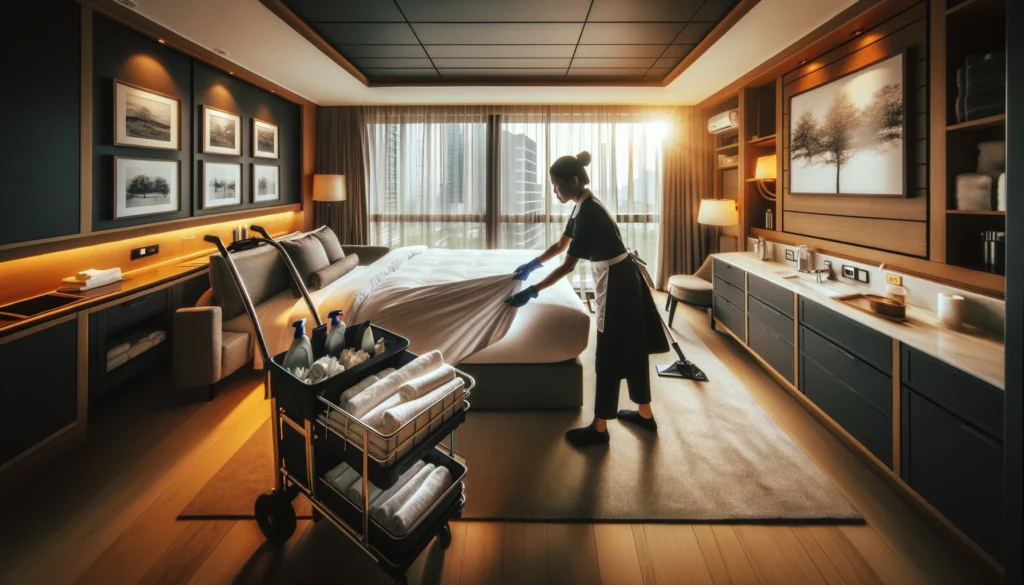
There is a moment that happens in hotels thousands of times a day, and almost nobody is tracking the cost of it. It’s the tipping gap nobody notices.
A housekeeper finishes a room. Fresh towels aligned, surfaces spotless, the kind of work that takes experience and care to do consistently well. The guest returns, notices immediately, reaches for their wallet. Nothing. They haven’t carried cash in two years. They feel a flicker of guilt, set their bag down, and move on with their evening.
The housekeeper never knows the guest wanted to tip them. The guest never finds a way to follow through. And the hotel, which employs that housekeeper and depends on her showing up tomorrow and the day after, has no idea this exchange just happened — or that it is happening dozens of times a day across every floor of the property.
This is the housekeeping tip gap. It is not a guest attitude problem. It is not a housekeeper performance problem. It is a structural failure sitting inside the most cash-dependent role in the building, at exactly the moment cash has disappeared from guests’ pockets.
Why housekeeping is uniquely exposed
Every tipped role in a hotel has a natural transaction moment. A valet returns your car. A bellhop carries your bags to the room. A bartender hands you your drink. These interactions end with eye contact, a handshake, a natural pause where gratitude can be expressed and received.
Housekeeping has none of that. The work happens while the guest is away. The worker and the guest rarely share the same space. There is no transaction moment, no natural exchange, no opportunity for a guest to act on the appreciation they genuinely feel.
This invisibility has always been a challenge. What has changed is that the one mechanism that worked — leaving a few bills on the nightstand — has quietly stopped working. Canary Technologies surveyed 1,000 hotel guests and found that more than 70% who did not tip during their most recent stay would have left a tip if a digital option had been available. The intent is there. The infrastructure is not.
For housekeepers, this plays out in take-home pay. The same study found that 70% of housekeepers reported their tips had stayed the same or declined over the past five years, at precisely the moment when their wages have become more important as a retention factor than at any point in recent memory.
What this costs a hotel
The tip gap is easy to dismiss as a worker welfare issue that sits outside the hotel’s direct financial exposure. The retention math says otherwise.
Industry benchmarks put US hotel hourly turnover at 60% to 75% annually, with housekeeping among the highest-turnover roles on any property. SHRM puts the minimum cost to replace a single hourly employee at $4,700, a figure that covers recruiting, onboarding, and basic training but excludes the six to eight weeks of reduced productivity while a new hire finds their footing. The American Hotel and Lodging Association puts the true all-in replacement cost closer to 25-30% of annual compensation.
As an illustrative example: a 200-room property with 40 housekeeping staff at 65% annual turnover would be replacing approximately 26 people per year. At a conservative $5,500 per replacement, the direct exposure is $143,000 annually, before a single additional cost is counted.
The connection to tip income is direct. Canary’s research found that nearly 80% of current hotel workers say they would be more likely to stay with their current employer if their tips increased. Housekeeping teams that receive consistent, reliable digital tips earn more, feel more recognized, and leave less often. The inverse is also true: teams whose tip income has quietly eroded over five years of declining cash carry are the same teams driving the turnover numbers that keep appearing on the GM’s monthly report.
The tip gap and the retention gap are the same gap. Hotels that address one address both.
The infrastructure problem has a straightforward solution
The reason housekeeping has been left out of digital tipping conversations is largely architectural. Most digital tipping products were designed for roles with fixed transaction moments — a POS terminal, a check, a counter. They work reasonably well for bartenders and room service. They do not work for a housekeeper who moves through twelve rooms in a shift and never shares a space with the guest she is serving.
NFC-based personal credentials solve this directly. A housekeeper’s TIPMO tag, worn as a keychain or clipped to a lanyard, can be left in the room during service. The guest returns, sees the room, picks up the tag, taps their phone. The tip page opens instantly. No app, no account, no friction. The transaction takes under ten seconds and the tip lands in the housekeeper’s account immediately.
The tag belongs to the worker, not the property. It travels with her between shifts, between floors, between jobs. Every tip she receives builds a verified record attached to her personal credential — a record she owns and carries regardless of where her career takes her next.
For the property, the implementation footprint is minimal. No PMS integration. No IT lift. No payroll reconfiguration. The hotel’s role is to equip its housekeeping team and get out of the way.
The question worth asking before the summer season ends
Housekeeping tip income is not a rounding error. For workers earning $28,000 to $35,000 annually in a role that depends on gratuities, the difference between a property with working digital tipping infrastructure and one without can represent thousands of dollars a year. That difference shows up in retention surveys, in exit interviews, and eventually in the cost of filling the same position for the third time in eighteen months.
The guests are already there. The intent to tip is already there. The only thing missing is a tap.
See how TIPMO closes the tip gap — schedule a demo at tipmo.com →